

쿠버네티스 주요 오브젝트와 오브젝트 간 연결
[Inflearn Warm-Up Club - DevOps] 매일 1% 성장하기
쿠버네티스 주요 오브젝트
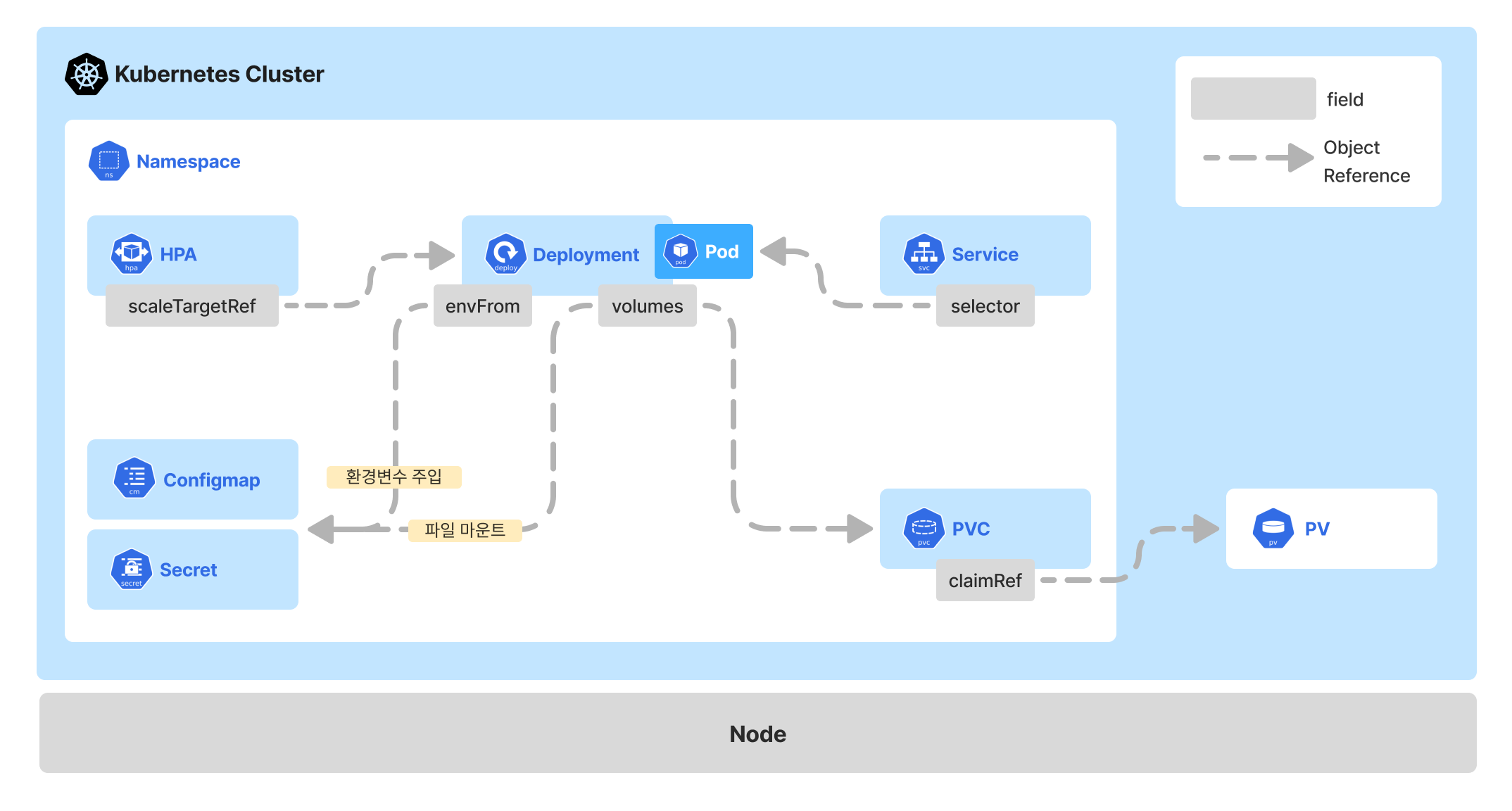
쿠버네티스는 다양한 오브젝트들로 구성되며, 서로 연결되어 애플리케이션을 배포하고 운영하는 데 핵심적인 역할을 한다.
Namespace
정의 및 역할
- 오브젝트들을 논리적으로 그룹화하여 구분
- 서로 다른 팀, 프로젝트, 환경(개발/운영 등) 간 리소스 충돌 방지
YAML 속성
apiVersion: v1
kind: Namespace
metadata:
  name: default
  labels:
    kubernetes.io/metadata.name: default
Deployment
정의 및 역할
- Pod의 생성과 업데이트를 관리하는 컨트롤러
- 선언한 상태에 맞춰 Pod 유지
YAML 속성
apiVersion: apps/v1
kind: Deployment
metadata:
  name: my-app
  labels:
    app: my-app
spec:
  replicas: 3
  strategy:
    type: RollingUpdate
    rollingUpdate:
      maxUnavailable: 1
      maxSurge: 1
  selector:
    matchLabels:
      app: my-app
  template:
    metadata:
      labels:
        app: my-app
    spec:
      nodeSelector:
        disktype: ssd
      containers:
        - name: my-container
          image: nginx:1.25
          env:
            - name: CONFIG_VALUE
              valueFrom:
                configMapKeyRef:
                  name: my-config
                  key: config-key
          ports:
            - containerPort: 80
          startupProbe:
            httpGet:
              path: /
              port: 80
            failureThreshold: 30
            periodSeconds: 10
          readinessProbe:
            httpGet:
              path: /healthz
              port: 80
            initialDelaySeconds: 5
            periodSeconds: 10
          livenessProbe:
            httpGet:
              path: /healthz
              port: 80
            initialDelaySeconds: 15
            periodSeconds: 20
          resources:
            requests:
              memory: "128Mi"
              cpu: "250m"
            limits:
              memory: "256Mi"
              cpu: "500m"
          volumeMounts:
            - name: config-volume
              mountPath: /etc/config
              readOnly: true
      volumes:
        - name: config-volume
          configMap:
            name: my-config
- replicas: 원하는 Pod 개수
- strategy: 롤링 업데이트 등 업데이트 방식
- template: 실제 생성될 Pod 정의
- nodeSelector: Pod가 스케줄될 노드 선택
- containers.image: 사용할 컨테이너 이미지
- env: 환경변수 설정 (ConfigMap/Secret 연동)
- startupProbe: 애플리케이션 최초 기동 확인
- readinessProbe: 서비스로 트래픽을 보낼 수 있는 상태인지 확인
- livenessProbe: 컨테이너가 살아있는지 확인
- resources: CPU/Memory 요청 및 제한
- volumeMounts + volumes: 볼륨 마운트 설정
Service
정의 및 역할
- 네트워크 트래픽을 적절한 Pod로 전달
- Pod의 IP가 바뀌어도 안정적으로 접근 가능
YAML 속성
apiVersion: v1
kind: Service
metadata:
  name: my-service
spec:
  selector:
    app.kubernetes.io/name: MyApp
  ports:
    - protocol: TCP
      port: 80
      targetPort: 9376
- selector: 연결할 Pod 라벨
- port: 서비스 포트
- targetPort: 실제 컨테이너 포트
Configmap
정의 및 역할
- 설정 데이터를 환경변수나 파일 형태로 주입
- 애플리케이션의 설정을 외부에서 분리 가능
YAML 속성
apiVersion: v1
kind: ConfigMap
metadata:
  name: game-demo
data:
  player_initial_lives: "3"
  ui_properties_file_name: "user-interface.properties"

  game.properties: |
    enemy.types=aliens,monsters
    player.maximum-lives=5
  user-interface.properties: |
    color.good=purple
    color.bad=yellow
    allow.textmode=true
secret
정의 및 역할
- 민감한 정보를 환경변수나 파일 형태로 주입
- ConfigMap과 유사하지만 base64 인코딩 필요
YAML 속성
apiVersion: v1
kind: Secret
metadata:
  name: dotfile-secret
data:
  .secret-file: dmFsdWUtMg0KDQo=
PV(Persistent Volumes) / PVC(PersistentVolumeClaim)
정의 및 역할
- Pod의 생명주기와 무관하게 데이터를 저장
- PV는 클러스터에 제공된 저장소, PVC는 Pod가 요청하는 저장소
YAML 속성
apiVersion: v1
kind: PersistentVolume
metadata:
  name: foo-pv
spec:
  storageClassName: ""
  claimRef:
    name: foo-pvc
    namespace: foo
---
apiVersion: v1
kind: PersistentVolumeClaim
metadata:
  name: foo-pvc
spec:
  accessModes:
    - ReadWriteOnce
  resources:
    requests:
      storage: 1Gi
HPA
정의 및 역할
- CPU/메모리 등 리소스 사용량에 따라 자동으로 Pod 수 조절
YAML 속성
apiVersion: autoscaling/v2
kind: HorizontalPodAutoscaler
metadata:
  name: php-apache
spec:
  scaleTargetRef:
    apiVersion: apps/v1
    kind: Deployment
    name: php-apache
  minReplicas: 1
  maxReplicas: 10
  metrics:
  - type: Resource
    resource:
      name: cpu
      target:
        type: Utilization
        averageUtilization: 50
status:
  observedGeneration: 1
  lastScaleTime: <some-time>
  currentReplicas: 1
  desiredReplicas: 1
  currentMetrics:
  - type: Resource
    resource:
      name: cpu
      current:
        averageUtilization: 0
        averageValue: 0
- scaleTargetRef: 스케일 대상 리소스
- minReplicas / maxReplicas: 최소/최대 Pod 수
- metrics: 기준 리소스 및 임계값
- behavior: 스케일 조정 정책
쿠버네티스에서 오브젝트 간 연결
쿠버네티스 오브젝트들은 label, selector, namespace, name 등을 통해 서로 관계를 맺는다.
네이밍 TIP
- 이름은 가독성과 관리 용이성을 고려하여 작성
- 운영 중에는 변경이 어렵기 때문에 처음부터 명확하게 네이밍
- 네임스페이스는 서비스나 도메인 기준으로 구분
Label & Selector
label
- 오브젝트에 메타데이터를 부여하여 그룹화
- 형식: key=value
- prefix를 붙여 충돌 방지 가능 (team.dev/app=foo)
selector
- 특정 라벨을 가진 오브젝트를 선택할 때 사용
- matchLabels 또는 matchExpressions 방식
Selector 사용 예시
| 오브젝트 유형 | 필드 위치 | 역할 및 설명 |
|---|---|---|
| Service | spec.selector | 연결할 대상 Pod의 라벨을 기준으로 트래픽 전달 |
| Deployment | spec.selector.matchLabels | 관리할 Pod 정의. template.labels와 일치해야 함 |
| ReplicaSet | spec.selector.matchLabels | 생성 및 관리할 Pod 그룹 선택 |
| HorizontalPodAutoscaler | spec.scaleTargetRef.name | 스케일 대상 리소스 (Deployment 등) 이름 지정 |
| PersistentVolume | spec.claimRef | PVC와 연결될 PV 식별 |
| PersistentVolumeClaim | metadata.name | PV의 claimRef.name과 매칭됨 |
| Pod | spec.nodeSelector | 특정 라벨을 가진 노드에만 Pod 스케줄링 |
| NetworkPolicy | spec.podSelector | 정책 적용 대상 Pod 선택 |
회고
이번 강의를 통해 쿠버네티스가 왜 선언적인 구조인지, 그리고 그 선언들이 어떻게 연결되는지를 조금 더 명확히 이해할 수 있었다.
각 오브젝트는 단독으로 존재하지 않고, label, selector, namespace 등을 통해 서로 연결된다. Deployment, Service, HPA 같은 컨트롤러들이 이 선언된 상태를 유지시키며 시스템이 원하는 상태로 작동하게 만든다.
이 구조 덕분에 쿠버네티스는 복잡한 운영 환경에서도 예측 가능한 상태를 유지할 수 있고, 우리는 선언만으로도 안정적인 인프라를 구성할 수 있게 된다는 것을 깨달았다.

어치 (Eurasian Jay)
Garrulus glandarius
어치는 참새목 까마귀과에 속하는 새로, 지능이 높고 경계심이 강하다. 깃털은 화려하며, 날개에 파란색 줄무늬가 특징이다. 주로 숲이나 공원에 서식하며, 도토리를 저장해두는 습성을 가진다.